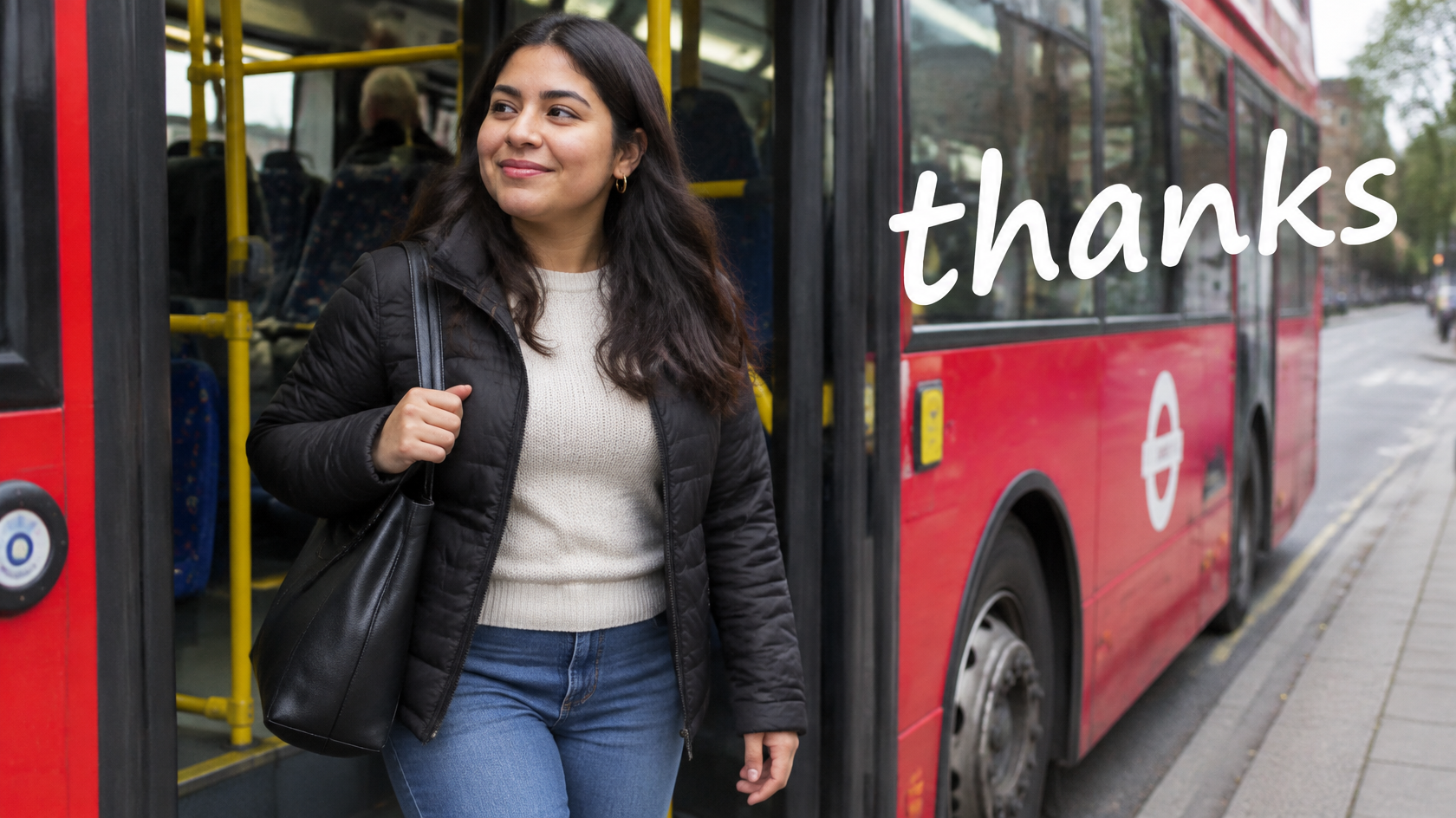
You’ve reached your stop. You gather your belongings, check that your phone hasn’t slipped into another dimension between the seats, and make your way towards the exit.
Then you hear it.
“Cheers, driver!”
Followed by:
“Thanks!”
And possibly a third passenger contributing a slightly breathless “Ta!” while attempting to retrieve a shopping bag from behind their knee.
Welcome to a small British custom: thanking the person who has just driven you somewhere, even though you paid them to do it.
Why do people thank the bus driver?
For many passengers, it’s simply a friendly acknowledgement of the driver’s work.
They’ve navigated traffic, pulled into stops, answered questions and transported a vehicle full of people who all need to be somewhere. A quick thank-you recognises the person doing the job.
We thank shop assistants and café staff too. Paying for a service doesn’t prevent us from being pleasant about receiving it.
There’s also something reassuringly ordinary about it. You might have spent the journey avoiding eye contact with everyone on board, but you can still finish with two friendly words.
A small social interaction, successfully completed. Excellent work. Off to the shops.
Does everyone do it?
It’s a friendly custom rather than a compulsory performance.
What should you say?
Keep it short. Any of these will do:
- “Thank you.”
- “Thanks, driver.”
- “Cheers!”
- “Cheers, driver!”
- “Ta!”
- “Thanks, have a good day.”
In this context, “cheers” means thank you. Nobody is proposing a toast, and you don’t need to raise a beverage.
“Ta” is another informal way of saying thanks. Short, efficient and particularly useful when you’re also trying to stop a bag of oranges escaping.
You don’t need to copy a local accent. Say it naturally in your own voice. You’re getting off a bus, not auditioning for a regional drama.
When do you say it?
As you leave, ideally when the driver can hear you and you can keep moving.
You don’t need to stop for a conversation, request a handshake or provide a review of their cornering technique.
A simple “Thanks!” on the way past is enough.
If the driver is helping another passenger or dealing with traffic, they may not reply. They may give a nod, a wave or a quick “cheers” back.
All perfectly normal. Your thank-you has been delivered; no receipt is required.
What if you’re leaving through the middle or rear door?
Use your judgement.
A brief raised “Thank you!” can work if the driver is within earshot. A small wave may also be appropriate.
There’s no need to shout through a packed bus with the urgency of somebody spotting a runaway horse.
And don’t walk back through boarding passengers purely to deliver your thanks. The driver will probably appreciate an orderly exit more than an elaborate farewell tour.
What if you’re wearing headphones?
You might accidentally say it rather louder than intended.
“THANK YOU, DRIVER!”
The driver now knows. So does everyone at the stop.
To avoid announcing your gratitude to the surrounding district, lower the volume or remove one earbud before speaking.
If you forget, carry on with dignity. You’ve been enthusiastically polite. There are worse things.
Is it strange to thank someone for doing their job?
Only if you think courtesy should disappear whenever money changes hands.
The fare pays for the journey. The thank-you acknowledges the human being helping you make it.
You’re not declaring the service flawless or promising lifelong loyalty to the timetable. You can appreciate the driver while still wondering why your bus only appears after you’ve opened a yoghurt.
If a service runs late, remember that the driver may be dealing with traffic or other delays beyond their control.
What if the driver has been particularly helpful?
If they’ve explained where to get off, waited while you safely boarded or helped you find the right service, a more specific thank-you is lovely.
“Thanks for your help.”
“Cheers for letting me know the stop.”
It doesn’t need to be a speech. Mentioning what helped makes the appreciation clear.
For assistance that made a real difference, you can also send positive feedback to the bus company afterwards, with the route, approximate time and direction of travel.
Drivers deserve to hear when somebody thinks they’ve done a good job, too.
Your first attempt
If you’re new to the UK, this is an easy custom to try.
Press the stop button in good time, gather your belongings and make your way out safely when the bus stops.
Then, as you leave:
“Cheers, driver!”
That’s it. A small acknowledgement, a friendly end to the journey, and you’re on your way.
Now check you’ve got your umbrella. Otherwise, you’re about to meet the same driver again much sooner than expected.