If you’re visiting the UK and someone invites you for a Sunday roast, accept with enthusiasm and consider how much breakfast you actually need.
You’re about to encounter a meal that can involve several pans, an oven operating at full capacity and somebody asking whether the potatoes are ready every four minutes.
A Sunday roast is a British tradition built around a substantial meal, usually enjoyed with family or friends. You’ll find it served in homes, pubs and restaurants, with enough variations to keep everyone discussing how their mum does it.
And their mum, you will discover, does it correctly.
What actually is a Sunday roast?
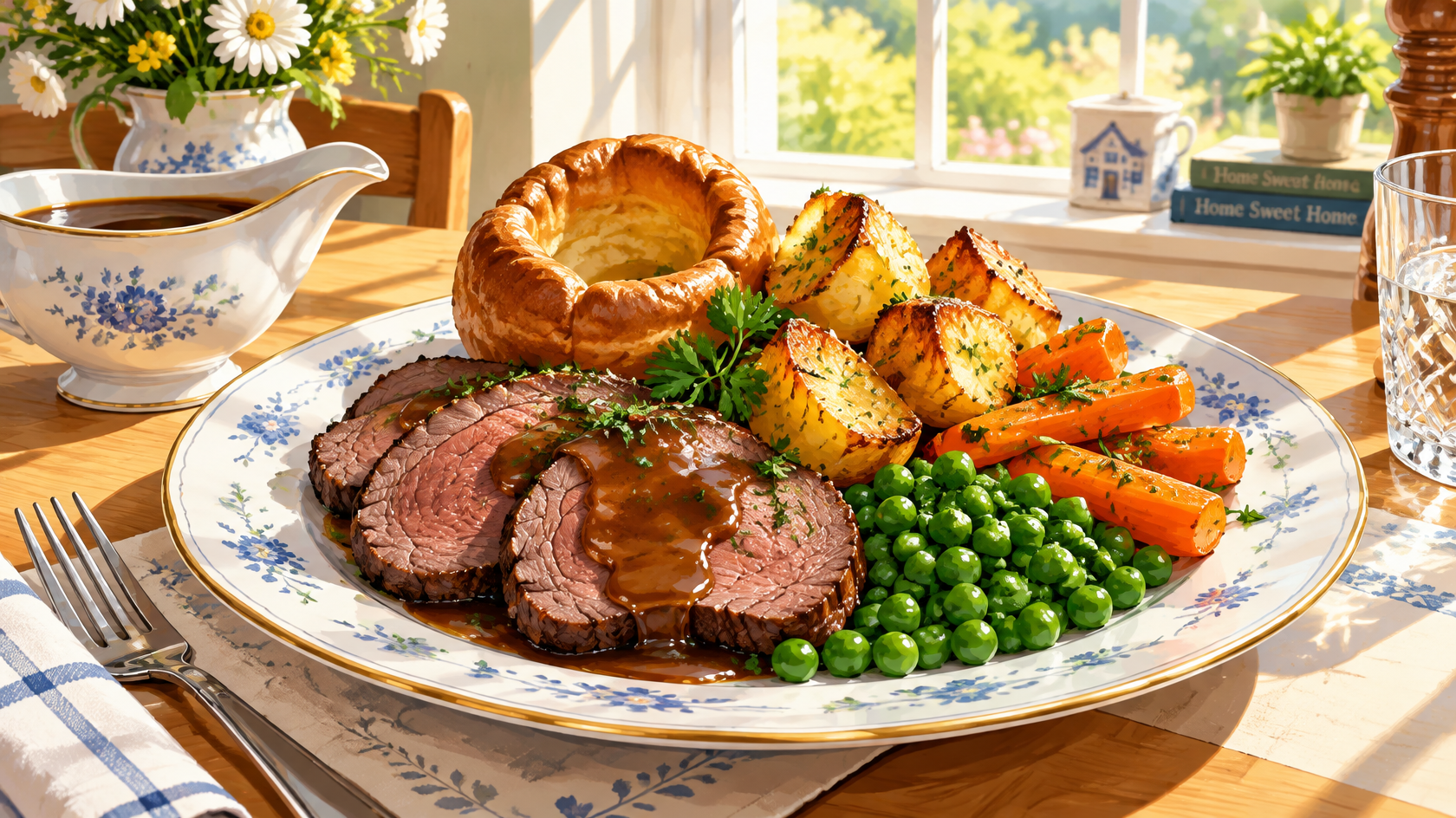
The usual arrangement is roasted meat, roast potatoes, vegetables and gravy, with extra accompaniments depending on what’s being served.
Beef, chicken, pork and lamb are familiar choices. Vegetarian and vegan roasts might feature a nut roast, mushroom Wellington or another centrepiece deserving of its own place at the table.
The meal is traditionally associated with Sunday, although there is no roast enforcement officer checking your oven on a Wednesday.
“Sunday dinner” may also mean a meal eaten around lunchtime. If you’re invited, ask what time to arrive. Turning up at six for a meal served at one is a bold way to secure a plate of leftovers.
Why Sunday?
Sunday has long been a customary day for families to gather for a substantial meal, often connected with the rhythm of the working week and churchgoing.
Today, you don’t need a religious reason or even a family gathering. Plenty of people simply enjoy the opportunity to sit down, eat well and spend the afternoon making increasingly ambitious promises about going for a walk.
The roast gives the day a focal point. It’s an occasion to catch up, pass things around and discover that somebody has strong views about carrots.
The roast potatoes: a serious appointment
The meat may receive top billing, but roast potatoes have an extremely committed following.
Ideally, they’re crisp and golden outside, fluffy inside and available in quantities that prevent anyone having to count how many everybody else has taken.
Household methods differ. People have opinions about the potato variety, cooking fat, seasoning and how enthusiastically to shake them after parboiling.
You may hear someone describe their technique with the intensity normally reserved for explaining how they survived at sea.
As a guest, “These potatoes are lovely” is a very useful sentence.
If they really are lovely, say it early. The cook has probably been monitoring them for an hour.
Yorkshire puddings: confusingly, not dessert
A Yorkshire pudding is made from batter and baked until risen and golden. It’s savoury, often crisp around the edges, and particularly associated with roast beef.
Many people happily serve Yorkshire puddings with other roasts too. Others have reservations. You may wish to avoid chairing that discussion during your first visit.
Despite the name, it isn’t a sweet pudding. Don’t save it for custard.
Its shape also makes it an excellent place for gravy to gather, which brings us neatly to the next department.
Gravy holds the operation together
Gravy is the savoury sauce poured over the meal. It might be made using roasting juices, prepared separately or produced with assistance from a familiar tub in the kitchen cupboard.
Different households prefer different thicknesses and quantities.
Some people add a modest drizzle. Others create a small inland sea and wait for a roast potato to establish a ferry service.
If you’re serving gravy to someone else, ask how much they want. “A bit” is not a recognised unit of measurement and may mean anything from two spoonfuls to “keep going until I look concerned”.
Vegetarian or vegan diners should check the gravy as well as the main dish, since it may contain meat stock or juices.
The supporting cast
Vegetables vary with the cook, the season and what was available at the shops. Carrots, peas, cabbage, broccoli and parsnips may all appear.
Cauliflower cheese sometimes joins the meal, bringing another dish to wash and another reason to be pleased you came.
There are also traditional pairings you’ll often encounter:
- Horseradish sauce with beef.
- Mint sauce with lamb.
- Apple sauce with pork.
- Stuffing and bread sauce with chicken or turkey.
These are accompaniments, not an entrance examination. You’re allowed to ask what something is, try a little or politely decline.
With pork, you may also be offered crackling: the crisp roasted skin. Enthusiasts will discuss whether it has achieved the correct crunch. Let them finish chewing before requesting their verdict.
Ordering a roast in a pub
Many pubs offer a Sunday menu with several roast options, including meat-free choices. Check what’s included rather than assuming every roast comes with every possible trimming.
Some places serve individual plates; others bring sharing dishes to the table.
A carvery works differently. Typically, you choose from meats carved at a counter and help yourself to the available accompaniments, following the venue’s serving arrangements.
Approach your plate with ambition tempered by engineering. A Yorkshire pudding perched on a mountain of potatoes may look impressive until you have to carry it.
Popular Sunday lunches can book up, and particular dishes may sell out. Check serving times and booking arrangements before making a special journey.
Invited to someone’s home?
Mention dietary requirements beforehand, offer to bring something and arrive at the agreed time.
A roast involves coordinating several things that all claim to need the oven at different temperatures. Your host may look relaxed while mentally managing a potato emergency.
Offer to help, but accept instructions. A busy kitchen is not always improved by an additional person standing directly in front of the drawer containing the serving spoons.
At the table, enjoy the food and the company. You don’t need to eat something you dislike or clear an enormous plate to prove your appreciation.
Complimenting the cook and offering to help clear up will go further than quietly concealing a parsnip.
And then there might be pudding
After the roast, someone may ask whether you’d like apple crumble, sticky toffee pudding or another dessert.
You will look at your empty plate and wonder how this is possible.
Then somebody will mention custard.
The Sunday roast is about familiar food, generous hospitality and time spent together. Every household has its own version, and discovering those differences is part of the pleasure.
Just leave room for the potatoes. Somehow, there are always a few more.